Tunisia–Finland Green Energy Bridge · Vision 2026–2045
Build the first project. Prove the platform.
A proposed 10 MWp solar PV project in El Faouar, Kébili, Southern Tunisia. Seeking experienced co-developers and development-capital partners to advance land, grid and feasibility work.
Project Zero in numbers
Proposed solar PV capacity
Design target
Indicative annual generation · GWh/year
Preliminary screening estimate
Required land area · hectares
Land rights not secured
GSA specific PV output · kWh/kWp/year
Modelled resource baseline
GSA horizontal irradiation · kWh/m²/year
Modelled resource baseline
These figures describe a proposed project. No land rights, grid allocation, authorisation, signed PPA or financing commitment are secured. Target pathway: authorisation regime, subject to applicable conditions and approvals. Intended electricity buyer: STEG.
View assumptions and project status
Source: supplied Global Solar Atlas report, generated 30 September 2026, for an indicative study point. 10,000 kWp × 1,797 kWh/kWp/year = 17.97 GWh/year, rounded to about 18. This is not a P50/P90 assessment or guaranteed grid export. Independent assessment is required. Land area: founder’s project request.
Global Solar Atlas ↗Updated 21 October 2026
From El Faouar, we begin
Project Zero and our wider vision
English narration · Arabic subtitles · 3:45
The company platform
From lived experience to a vision for a better future
Mokhtar Benothman, a native of El Faouar in south-western Tunisia now based in Finland, launched the Blue Green Energy Bridge initiative out of his attachment to his homeland and his own experience of intense summer heat and frequent power and water cuts, and their impact on daily life in the community.
From that experience grew the Tunisia–Finland Green Energy Bridge Vision 2026–2045: connecting local knowledge with expertise, technology and investment to help develop practical clean-energy solutions and open opportunities for training and local development in southern Tunisia.
Project Zero, a proposed 10 MWp solar PV project in El Faouar, Kébili, is the starting point of this vision: developing clean electricity generation intended for sale to Tunisia’s national grid through STEG. We invite development, technology and investment partners to help turn this vision into projects ready for implementation, step by step.
From El Faouar, we begin. Together, for our children's future.
Explore Project Zero and partnership opportunities →Legal status
Company name reserved with Tunisia’s RNE. SARL incorporation in progress.
Blue Green Energy Bridge
Company and project-development platform.
Tunisia–Finland Vision
The 2026–2045 strategic direction.
Project Zero Tunisia
The proposed first development project.
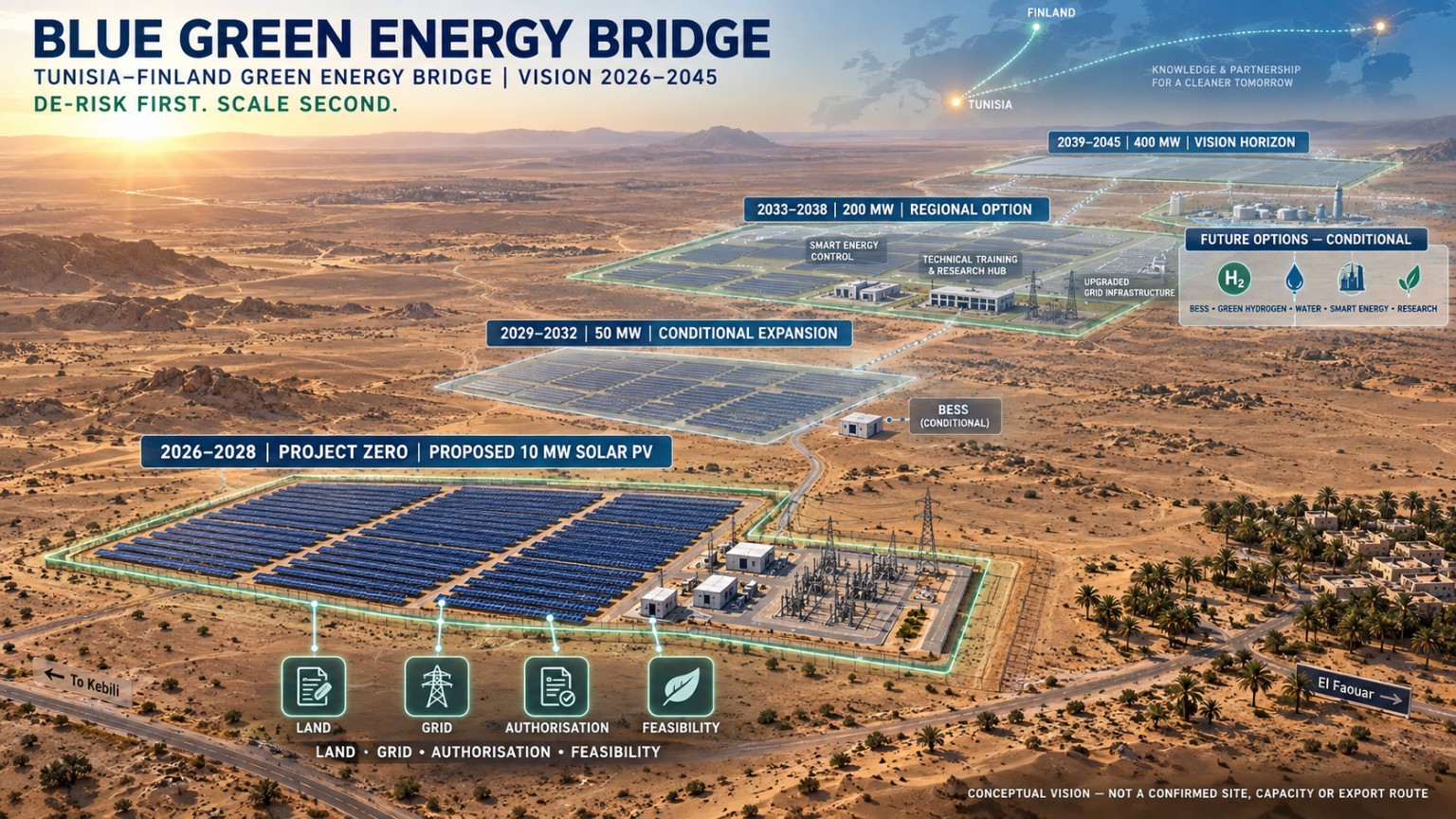
First development project · proposed
Project Zero Tunisia
10MWp solar PV proposed
A founder-originated solar opportunity with local administrative engagement and a preliminary solar-resource baseline. The next investment case will be built around a confirmed parcel, a STEG connection study and independent feasibility.
- Indicative area
- El Faouar, Kébili · Southern Tunisia
- Current scope
- Preliminary technical and economic studies; independent validation to follow
- Immediate priorities
- Land pathway, grid assessment, authorisation route and bankable feasibility
- Decision rule
- No scale-up before the required evidence gates are cleared
The final site and all land rights remain subject to legal, technical and environmental verification. No land right, grid allocation, permit, PPA, financing, EPC appointment or construction decision is claimed.
A preliminary resource baseline
Global horizontal irradiation · kWh/m²/year
Specific modelled PV output · kWh/kWp/year
Indicative annual generation for 10 MWp · GWh
Source: supplied Global Solar Atlas report, generated 30 September 2026 (World Bank / Solargis), for an indicative study point in the target area. Ground-mounted system, 1,000 kWp, south-facing, 35° tilt. Output of 1.797 GWh/year scales arithmetically to about 17.97 GWh/year for 10 MWp. This is screening information, not a P50/P90 study or a guaranteed grid export. Final design, soiling, availability and grid constraints require independent assessment.
Global Solar Atlas · World Bank / SolargisPreliminary feasibility · October 2026
Technical and economic preliminary studies are available. Project Zero remains in development; independent validation and project-specific approvals are the next steps.
Indicative annual energy
Two preliminary screening estimates are available: about 18 GWh/year from Global Solar Atlas scaling and about 16.1 GWh/year of grid sales from a HOMER model. They rely on different assumptions and boundaries, which have not yet been reconciled. Neither is a guaranteed or probability-based yield; an independent yield assessment will establish the reference figure.
Current development status
Land rights, a STEG connection study, authorisations and financing remain to be secured. The study point is a climate reference, not a confirmed project parcel.
What makes the project investable
The preliminary work identifies a clear route to strengthen the investment case: competitive EPC procurement, a confirmed grid solution and financing matched to project revenues. These conditions will be tested through supplier offers and independent review before an investment decision.
Partners sought
Experienced co-developers and development-capital partners to advance land rights, independent studies, grid assessment and authorisations through agreed milestones.
Download executive summary (English PDF · 2 pages)Request the detailed study and discuss participation
Updated 6 October 2026. Based on the supplied preliminary technical and economic reports, Global Solar Atlas and a separate annual financial screening model. No new HOMER simulation or independent engineering certification is claimed.
Project Zero — Development Roadmap
Indicative roadmap, not completed milestones. Workstreams can overlap; progression depends on evidence and approvals.
Land rights, grid connection, authorization, PPA and financing are not yet secured. Storage remains subject to feasibility.
Project definition
- Confirm 10 MWp scope
- Define objectives and assumptions
- Identify required evidence
Land and site control
- Verify title, access and boundaries
- Secure suitable site documentation
- Confirm land approval pathway
Partners and development rights
- Verify technical references
- Agree consortium roles and rights
- Define equity and funding obligations
Grid and technical studies
- Obtain STEG preliminary study
- Prepare layout and yield assessment
- Estimate connection costs
Environment and stakeholders
- Environmental screening
- Agricultural non-objection
- Local stakeholder consultation
Preliminary financial case
- Validate CAPEX and OPEX
- Test tariff, debt service and FX risks
- Seek bank financing agreement in principle
Application and Ministry approval
- Confirm window and required documents
- Arrange bid security and submit
- Obtain Ministry agreement in principle
SPV and detailed development
- Establish project company
- Implement agreed rights and governance
- Complete detailed studies and approvals
PPA and financial close
- Execute applicable PPA arrangements
- Satisfy lender conditions
- Complete financial close
Procurement and notice to proceed
- Finalize EPC and supply contracts
- Confirm construction readiness
- Issue notice to proceed
Construction and commissioning
- Build and supervise works
- Test and obtain required approvals
- Achieve commercial operation
Operations and performance
- Operate and maintain
- Monitor yield and payments
- Review performance and lessons
PPA and approval timing must follow applicable procedures. This roadmap complements the decision gates; it does not replace them.
Project Zero is the proposed starting project, not the full platform ambition. Its purpose is to validate a development model capable of supporting larger stages. Progression occurs only where land, grid, authorisations, commercial structure and financing are confirmed.
01Proposed start
10 MWp
Project Zero
Proposed 10 MWp solar PV reference project. A storage option will be assessed within feasibility; no storage capacity or budget has been adopted.
02Conditional expansion
~50 MWp
First expansion
A larger development stage after the model and delivery structure are validated.
03Conditional portfolio
~200 MWp
Regional scale
Multiple opportunities advanced under separate site, grid, regulatory and investment decisions.
042045 ambition
400+ MWp
Platform ambition
Long-term ambition: solar, storage, renewable-powered water, green hydrogen and knowledge transfer. Each opportunity requires separate feasibility and financing.
Growth beyond Project Zero will follow the legal pathway and proven feasibility of each project: the authorization regime, self-generation for eligible consumers, partnership in public concession tenders, or joining existing projects. Each step is decided by the competent bodies of each project company, in line with Tunisian law and the contractual rights of all parties.
Claims discipline
All post-Project Zero capacity figures shown above are strategic ambitions, not an owned, permitted, contracted or financed pipeline. Each stage is conditional and may comprise one or more projects.
Project Zero: the path to construction
Seeking technology and investment partners · Proposed Centre of Excellence, Kébili
Project Zero · Proposed 10 MWp solar PV
Land rights, grid connection, authorisation, PPA and financing secured?
No
Pause, reassess or redesign
Reassess the conditions before proceedingYes
Construction and operation · Electricity sales to STEG
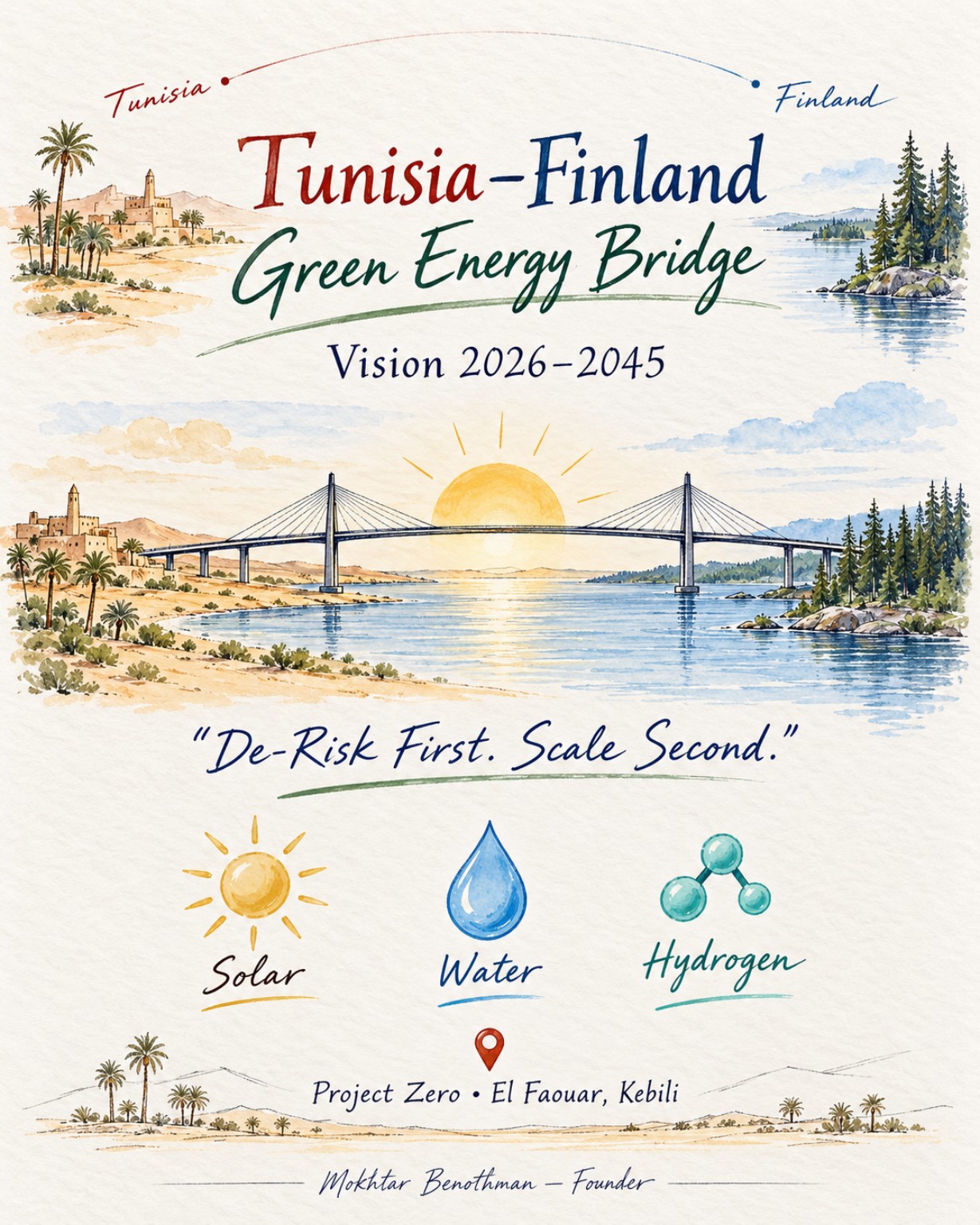
Development pillars and decision gates
Reference project: 10 MWp solar PV. A storage option will be assessed within the feasibility study; no storage capacity or budget has been adopted.
Storage assessment must identify the economic or contractual benefit that justifies its cost. If no sufficient benefit is demonstrated, storage will be excluded from the project scope.
Solar PV
Land-control instrument and STEG connection assessment for Project Zero. Confirmed regulatory pathway, independent yield and environmental studies, viable financial model.
BESS
Assess services, operating needs, losses and total storage cost. An evidenced revenue or contractual benefit that supports the investment; integration or separate SPV as appropriate.
AI and smart energy
Collect reliable production, weather, dust and maintenance data. Demonstrated improvement against a baseline; usable data and sustainable service economics.
Decarbonisation
Define an emissions baseline and measurement method. Independent verification where required; no carbon-credit income assumed before eligibility is established.
Water and desalination
Assess demand, water source, energy needs and brine management. Resource rights, permits, environmental acceptability, customer and viable water-service economics.
Green hydrogen and ammonia
Assess coastal locations, renewable electricity, sustainable water, buyers and logistics. Separate water budgets must protect household and oasis needs. Progress requires credible offtake, safety, certification, permits and competitive economics.
Each stage of the vision would be developed as a separate project, under the authorization regime or a concession procedure depending on its individual capacity and the applicable framework. Portfolio size does not determine the procedure; each project is assessed on its own.
Centre of Excellence for energy knowledge exchange
Our ambition is to help advance Tunisia’s energy sector and build a hub for knowledge exchange across Africa, the Arab world, the Mediterranean and Europe.
The proposed centre begins as an open framework for applied research, training and knowledge transfer. Its first proposed pilot measures dust, panel cleaning and water use for Project Zero, comparing practical cleaning methods before adopting AI. Local measurements will test the potential benefit; no savings are guaranteed.
The Centre of Excellence would seek cooperation with universities and research centres in Tunisia and Finland. No cooperation agreement exists at this stage.
An open invitation to contribute
Universities, research centres, companies and public institutions from all regions are welcome to propose or lead a study, a pilot or a training programme with BGEB. We welcome initiatives that demonstrate practical value for Tunisia and potential exchange across Africa, the Arab world, the Mediterranean and Europe.
Each collaboration will define its scope, funding, responsibilities, data access, intellectual property and publication rights in writing.
Propose a research or training initiativeWater: three regions, distinct needs
Kébili: groundwater protection, efficient oasis water use, reuse and suitable brackish-water treatment. Gabès and Médenine: coastal desalination and industrial water options. Each opportunity requires a permitted source, specified water quality, a paying customer, delivered-water economics and an acceptable brine solution. Desalination does not itself resolve groundwater depletion.
Decision architecture
De-risk first. Scale second.
Each stage must produce evidence strong enough for the next decision. Ambition follows readiness—not the other way around.
Land
A documented, legally viable and suitable site pathway.
Grid
Connection capacity, route, cost and timetable assessed.
Authorisation
The regulatory route mapped and approvals pursued in sequence.
Feasibility
Technical, environmental and commercial assumptions tested.
Bankability
Delivery structure, revenue logic and financing readiness aligned.
Governance · transparency · engineering discipline · local value
Who decides the pace?
The vision is indicative, not a fixed delivery schedule. Each project’s competent governing body decides whether to advance, hold, restructure or stop, considering technical advice and lead financiers’ contractual approval rights, under Tunisian law and in the project’s interest. The legal form, reserved decisions, BGEB’s role and rights will be defined in written agreements. Funding does not automatically confer control over BGEB or other projects.
Local value, measured in practice
The platform starts in El Faouar, a region of oases, dates and desert tourism, and aims for clean energy to support these local sectors.
We aim to strengthen economic vitality and social inclusion in southern and border regions through decent work, training, local businesses and efficient energy and water solutions. Kébili, Gabès and Médenine are priority areas for the water, hydrogen and ammonia vision. Benefits depend on viable projects and documented local delivery plans; a grid-connected solar plant does not by itself guarantee cheaper household electricity.
Indicators will distinguish construction job-years and peak headcount from permanent full-time jobs, and track training, local procurement, measured water savings and environmental performance. Targets will be set after project-specific studies; no employment or savings totals are promised.
Partnership and project structure
BGEB originates and coordinates the development of renewable-energy projects in Tunisia, working with qualified technical partners and investors to advance each opportunity from early site identification toward an investment decision and, ultimately, financial close. Project-specific roles, funding and participation are agreed transparently through dedicated contractual arrangements.
The platform and project companies
BGEB coordinates origination, local stakeholder dialogue, administrative pathways and qualified specialist contributions. A dedicated Tunisian project company (SPV) is proposed for each project that can support its own contracts and financing. A technology does not automatically require a separate company. The Centre of Excellence supports research and training; it does not automatically own or control the SPVs.
Investor entry and governance
Investors and developers may participate in the project matching their expertise. Contributions, valuation, equity, decision rights, budgets and milestones will be negotiated and documented. Project rights are distinct from rights over BGEB or its future pipeline. Development exclusivity should be limited in scope and time, with measurable obligations, termination rights and clear ownership of studies. Transactions between BGEB and SPVs require transparent pricing and appropriate approval.
Potential revenue model
Potential BGEB income includes milestone-based development fees, negotiated developer equity reflecting documented contributions and risk, and contracted services such as local coordination or monitoring. These are proposed commercial options, not acquired rights or guaranteed revenue. Services must be demonstrably useful and should avoid charging twice for the same contribution.
International cooperation
Develop the first project with us.
We welcome experienced renewable-energy developers, technical specialists and investors able to fund early development milestones. BGEB contributes project origination, local knowledge, community dialogue and administrative coordination. Cooperation terms will be negotiated for the specific project.
A project-specific partnership
Proposed structure: a dedicated Tunisian project company (SPV), with contributions, responsibilities, milestones and governance agreed in writing. Equity and financing terms remain open to negotiation; no partner rights are granted by this website.
The next deliverables
A written land-control instrument; STEG connection assessment; confirmation of the authorisation pathway; independent yield study and environmental scoping; a costed development plan and financial model.
Introduce your proposed role, relevant project references and the milestone you can help deliver.
Discuss Project ZeroFinancing pathways to assess
BGEB and qualified investors may structure Tunisian project companies and explore commercial or development finance, directly or through local banks, and appropriate guarantees. Eligibility, borrower structure, costs and conditions are assessed separately. Exploratory dialogue is possible at the current stage with full disclosure. No financing or guarantee has been secured.
For authorised solar projects above 2 MW and up to 10 MW, the October 2024 tariff framework allows euro indexation matching documented foreign-currency financing, capped at 80%, subject to approval; monthly billing remains in TND. Expansion contracts may differ. Investment grants may require a reduced tariff. Screening models are internal tools, not verified returns or financing offers.
Events / Événements / فعاليات
First German–Tunisian Business Forum
Development dialogue
Discuss your role in Project Zero.
Contact the founder to discuss co-development, technical studies or development capital. Share your relevant project references and proposed contribution.
Business enquiries: contact@bgebridge.com.
 Tunisia–Finland
Founder contact
Mokhtar Benothman
CEO & FounderSave the current contact details directly. Display the QR only when another person is ready to scan it.